High earn
Classifiers / MeasureP
Prenominal vs postnominal = two packaging geometries. Counters inert for verbal θ-slots. Examples →
Stroke order · ordered realization
Surface arity · packaging
A four-place sentence is still one geometry plus one packaging. Morphology is one of the places packaging freezes — with kanji as orthographic correlate, not as the packaging device.
Today’s morphology is yesterday’s syntax. Givón tradition (1971 ff.) — labeled lean
A four-place sentence is still one geometry plus one packaging. Grant / Tritransitive project — working hypothesis
Together: morphology is one of the places packaging freezes. That is a research stance, not a finished theorem.
| Layer | Question |
|---|---|
| Lexical arity | How many arguments does the predicate’s entry license? |
| Surface arity | How many distinguished participant phrases appear in the clause? |
| Event geometry | What is the underlying participant structure? |
Morphology is often why they diverge in a given language.
| Device | What it does | Example family |
|---|---|---|
| Affixal Appl / Caus | Increases or rearranges surface participants | Japanese causative -(s)ase |
| Case paradigms | Spell roles without adding event arguments | Acc / Dat / Instr MeasurePs |
| Light verbs | Borrow θ-roles from a noun / VN | VN + suru (G&M 1988) |
| Classifiers / MeasureP | Package amount + unit inside the nominal spine | Num+Cl (Oho 2019; Watanabe 2006) |
| Compound / stem fusion | Freeze older composition into opaque lexemes | Opaque two-kanji compounds |
Kanji’s job in this list: orthographic correlate of stems, VNs, counters, compounds — not the syntactic device.
High earn
Prenominal vs postnominal = two packaging geometries. Counters inert for verbal θ-slots. Examples →
High earn
Argument Transfer redistributes θ-roles. Surface arity ≠ piece arities. Examples →
Low earn / fossil
Scalar bleaching (勉強, 挨拶). Illustrative of fossil packaging. Examples →
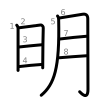
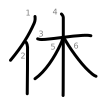
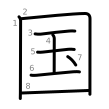
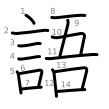
The clause-level slogan — surface arity is not event geometry — has a graph-local echo, and it does not replace the earn path above. A KanjiVG layout frame opens a few component slots. Stroke count is only how long the ordered realization runs. 明 and 休 are both deep-2; surfaces 8 and 6. 国 is deep-2 as well (outer 囗 + inner 玉) at surface 8, with the enclosure split by kvg:part. 語 is deep-2 at surface 14. These numbers are not linguistic arity.
Trees, the enclosure leave-and-return, and the REAL / SPECULATIVE map: Strokes. Reading the frame as Apply(frame, arguments) is a SPECULATIVE local model.